
As commercial expansion and military use intensify, outer space is becoming a governance challenge that existing law is ill-equipped to handle.
When a satellite malfunctions in orbit, it does not fall neatly within national borders. When fragments of space debris collide, they do not carry flags. And when private corporations deploy constellations of hundreds of satellites, the consequences are global affecting communications, climate monitoring, navigation, disaster response, and national security.
Yet the legal framework governing outer space was designed for a very different era.
The foundational rules of space law emerged in the 1960s and 1970s, when only a handful of States had access to space and almost all activity was government-led. The 1967 Outer Space Treaty declared space the “province of all mankind,” prohibited the placement of weapons of mass destruction in orbit, and made States responsible for national space activities. It was visionary in its time. But it did not anticipate billion-dollar private space corporations, mega-satellite constellations, space tourism, lunar resource ambitions, or the strategic militarization of space technologies.
Today, humanity operates in a legal framework shaped by the Apollo age while navigating a commercial and geopolitical environment far more complex.
A Commercial Rush Ahead of Regulation
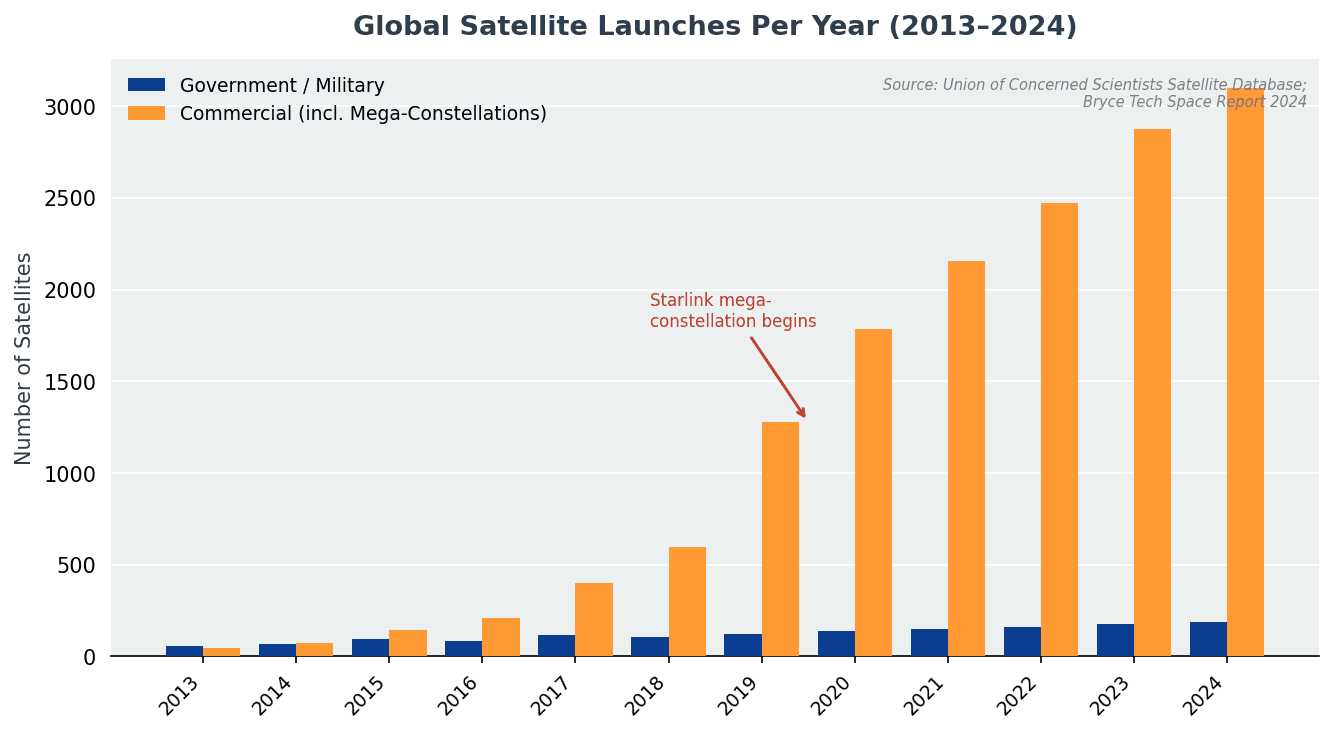
Private actors are no longer peripheral. Companies now launch satellites for broadband internet, earth observation, defence applications, navigation services, and data analytics. Thousands of satellites are being placed in low Earth orbit, dramatically increasing congestion and the risk of collisions. A single debris-generating event could trigger cascading impacts, damaging orbital infrastructure that underpins banking systems, aviation safety, disaster management, and military operations on Earth.
Despite this, space traffic management remains largely dependent on voluntary guidelines rather than binding international rules. There is no global enforcement authority, no universally accepted mechanism for allocating orbital positions, and no robust liability framework for long-term debris damage. The result is a legal grey zone where commercial speed far exceeds regulatory control. This is not merely a technical issue; it is a governance challenge. Outer space has become an extension of critical infrastructure. Weak legal oversight in orbit can translate directly into economic disruption and security risks on the ground.
Artificial Intelligence: A Double-Edged Satellite in the Sky
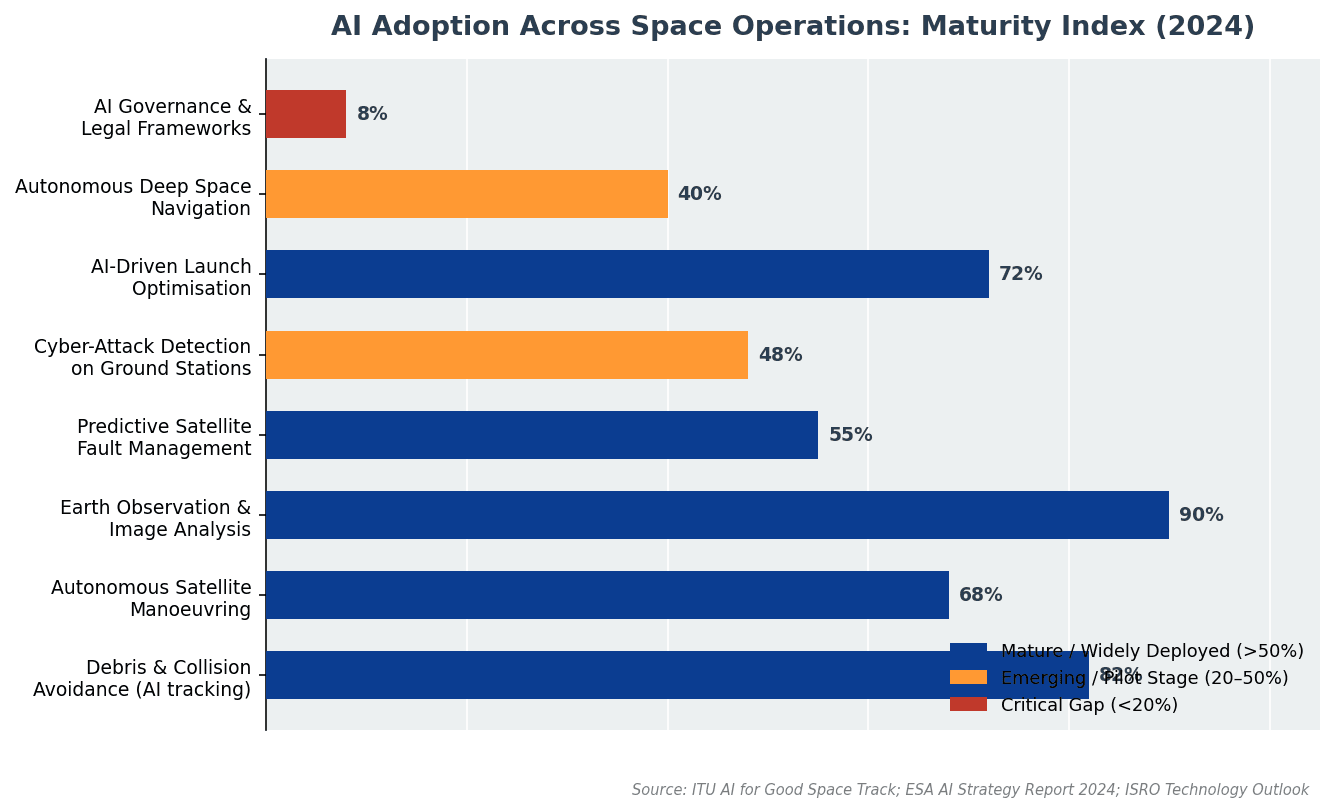
Artificial intelligence is rapidly transforming every dimension of space operations, from autonomous satellite manoeuvring and real-time debris tracking to predictive analytics for collision avoidance. Space agencies and private operators increasingly rely on machine learning algorithms to process the vast data streams generated by thousands of orbital objects — data that no human team could monitor or analyse in real time. ISRO has begun integrating AI-powered tools in its ground control systems, and IN-SPACe, India’s space regulatory body, has acknowledged the role of AI-enabled technologies in the expanding commercial space pipeline.
Yet existing legal frameworks remain entirely silent on AI in orbit. When an AI-controlled satellite autonomously executes a collision-avoidance manoeuvre that inadvertently damages a neighbouring object, the Outer Space Treaty offers no clear guidance on liability. When deep learning systems interpret satellite imagery for intelligence purposes, questions of proportionality and international humanitarian law arise without resolution. The governance gap is not merely about commercial speed — it is about algorithmic decision-making that can now occur in microseconds, far beyond the reach of any legal review or human oversight.
Militarisation Without Clear Guardrails
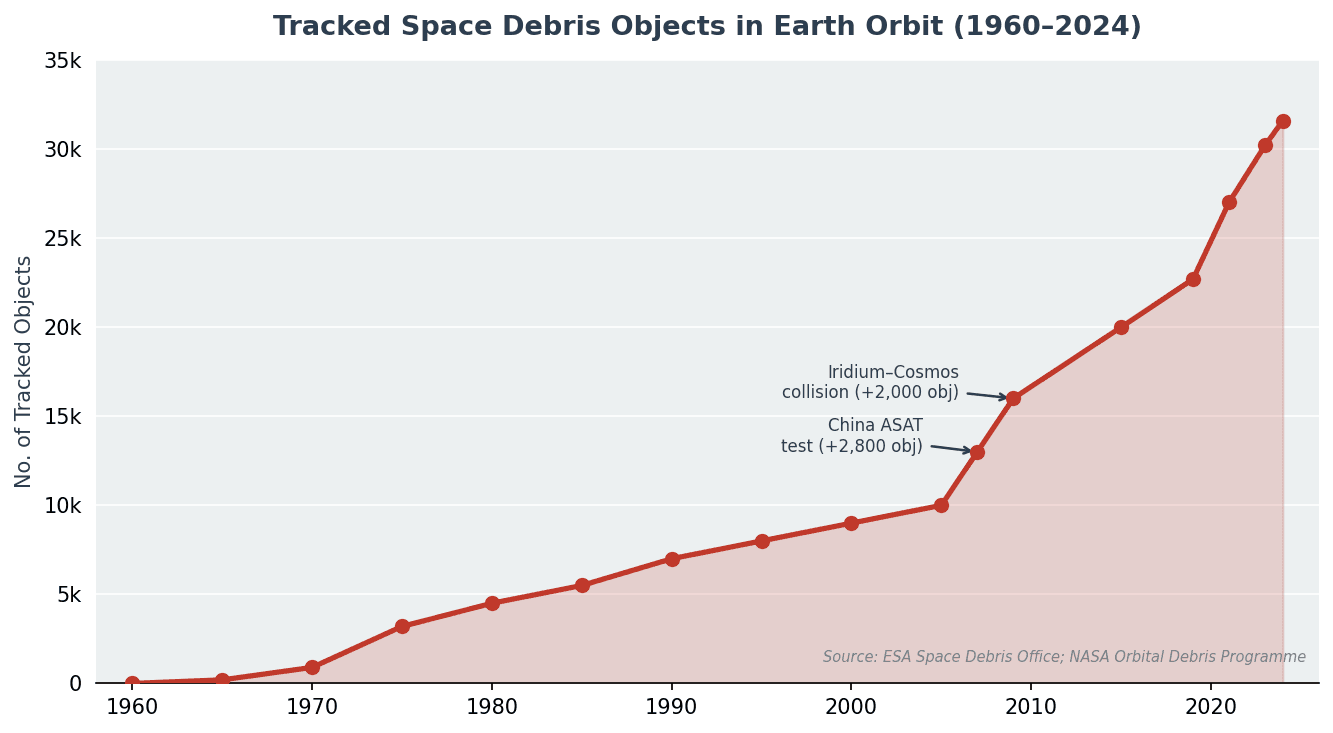
Space is also an increasingly strategic domain. Satellites enable missile warning systems, surveillance, secure communications, and navigation. Anti-satellite (ASAT) weapon tests conducted by several States have already generated hazardous debris clouds, demonstrating how military actions in orbit can have lasting environmental consequences.
While the Outer Space Treaty prohibits weapons of mass destruction in space, it does not ban conventional weapons or ASAT systems. Nor does it clearly regulate cyber interference with satellites. These gaps heighten the risk of miscalculation and escalation, particularly during geopolitical tensions. Actions in orbit whether deliberate or accidental could have strategic consequences without a clear legal framework to determine responsibility or manage disputes.
Artificial intelligence amplifies these risks significantly. AI-enabled systems are already being developed for autonomous target identification, electronic warfare, and cyber intrusion into satellite command networks. A state actor — or a well-resourced non-state group — could deploy AI-driven cyberattacks to disable navigation or communication satellites, with cascading consequences for civilian infrastructure worldwide. India, which relies on NAVIC for strategic navigation and GSAT satellites for critical communications, is acutely exposed to such threats. International space law has yet to define what constitutes a prohibited act of aggression in the cyber-space domain, leaving a dangerous vacuum that AI-driven capabilities are rapidly filling.
Why the Developing World Cannot Be a Bystander
Space governance is not solely a superpower concern. Developing countries rely heavily on satellite services for weather forecasting, agricultural planning, telemedicine, education, and disaster response. For many, space is not a prestige project but a development necessity.
If key orbital regions become monopolised by a few powerful States and corporations, or if debris renders orbits unusable, the consequences will fall disproportionately on countries with limited space capabilities. The principle of equitable access to outer space central to early space law risks being sidelined at a time when it is most needed.
Countries like India, with expanding space programmes and growing private participation, occupy a unique position. They bridge the developed and developing worlds and can advocate governance models that balance innovation, security, and equitable access.
India’s Digital Ecosystem: A Platform for Space Technology Leadership
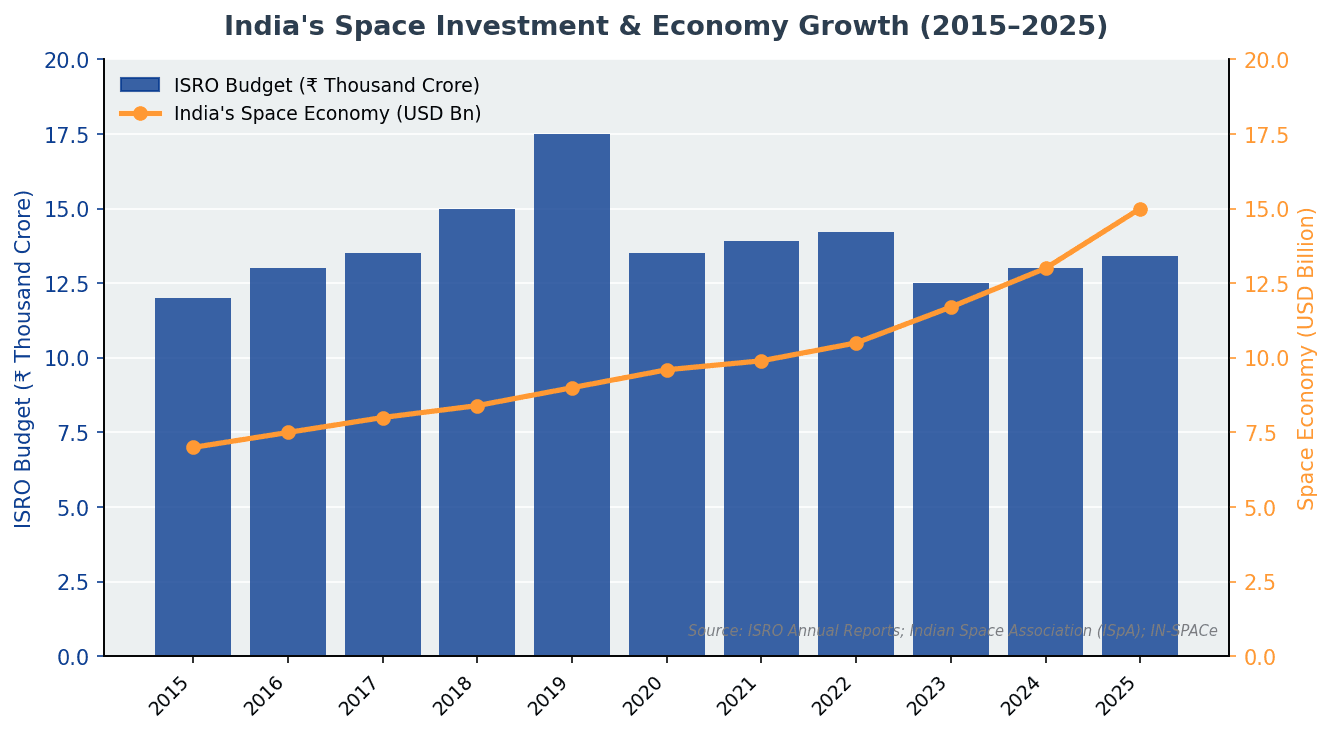
India today is among the world’s fastest-growing technology ecosystems, with a robust artificial intelligence research community, a thriving deep-tech startup culture, and a government-backed National AI Mission (IndiaAI) driving adoption across sectors from agriculture to healthcare. These capabilities are increasingly intersecting with the space domain. Indian new-space startups such as Pixxel, SkyServe, and Dhruva Space are building AI-driven earth observation platforms, data analytics satellites, and commercial launch services — placing India at the vanguard of the new space economy well ahead of many established space-faring nations.
ISRO’s ambitious mission pipeline — including Gaganyaan, Chandrayaan-4, and the planned Bharatiya Antariksha Station — will increasingly depend on AI-assisted systems for autonomous operations, predictive fault management, and real-time mission planning in deep space environments where round-trip signal delays make human intervention impractical. This integration of AI into sovereign space capabilities raises critical regulatory questions: who bears liability when an autonomous spacecraft malfunctions and causes damage? How should AI-generated satellite surveillance data be classified, shared, and governed under international law? India’s forthcoming Space Activities Bill and the IN-SPACe regulatory framework must explicitly address these questions to build a credible and forward-looking legal architecture.
India’s position as a leading voice in the Global South, combined with its technological sophistication, equips it to champion AI governance norms in outer space that are inclusive, transparent, and anchored in sustainable development. As digital and space infrastructure converge — through satellite internet connectivity, remote sensing for precision agriculture, and AI-driven disaster prediction systems — the governance choices made today will determine whether technology in orbit serves all of humanity or only the most powerful.
The Limits of National Laws
Many States are introducing domestic space legislation to regulate private operators. While essential, fragmented national approaches cannot address inherently global challenges such as debris mitigation, space traffic coordination, and resource utilisation. Space is a shared and finite environment; unilateral regulation is insufficient.
What is required is a multi-layered governance framework. This includes stronger international norms on debris prevention and space traffic management; transparency and confidence-building measures to reduce military mistrust; clearer liability and insurance mechanisms for commercial operators; and meaningful inclusion of developing nations in decision-making forums. Cooperation, not competition alone, must guide governance in orbit.
A Narrow Window for Action
Unlike oceans or airspace, damage in space can be long-lasting. Debris may remain in orbit for decades, compounding risks over time. Regulatory delay today could produce irreversible hazards tomorrow.
Space law must shift from being reactive to anticipatory. Policymakers, scientists, lawyers, technologists, and industry leaders need to collaborate to update legal frameworks before crises force fragmented and inadequate responses. This collaboration must explicitly include AI experts: as autonomous systems and machine learning become inseparable from space operations, technical governance of algorithms and data systems must be integrated into space law rather than treated as a separate domain. The rapid adoption of AI in orbit is not a future prospect — it is a present reality, and the legal system must catch up. Governance of outer space is no longer a niche academic subject; it is tied to economic stability, environmental responsibility, technological equity, and international peace.
The question is no longer whether stronger space law is needed, but whether the international community can build it in time. The sky above us is no longer empty. How we choose to govern it will shape the future of life below.